
With shouts of excitement, laughter and the booming of fireworks, Taiwanese pop stars A-Mei and A-Lin headlined the Taitung New Year’s celebration. Held in her hometown this year, the performance was made extra special by A-Mei, a member of Taiwan’s Puyuma Tribe, who brought together singers from several indigenous groups of Taiwan, including A-Lin from the Amis Tribe and Sangpuy from the Puyuma Tribe. The performance deeply embraced Taiwan’s pop culture as a whole, with thousands watching. To get to know the tribes of Taiwan better, below are three of the most well-known today.
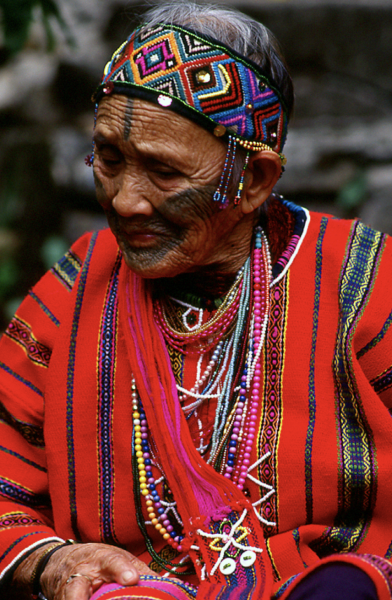
Woman with Ptasan. [PHOTO COURTESY OF C.Y HSIAO UNDER CC BY-SA 4.0]
Atayal
The Atayal people are one of the most widespread indigenous tribes in Taiwan, with a population that reached around 92,084 in 2020. They live in northern and central mountain regions of Taiwan, such as New Taipei City, Taoyuan City, Miaoli County, Taichung City, Nantou County and Yilan County. They are most known for their facial tattoos called Ptasan, which are not only marks of beauty but also protection from evil spirits and identification for the afterlife.
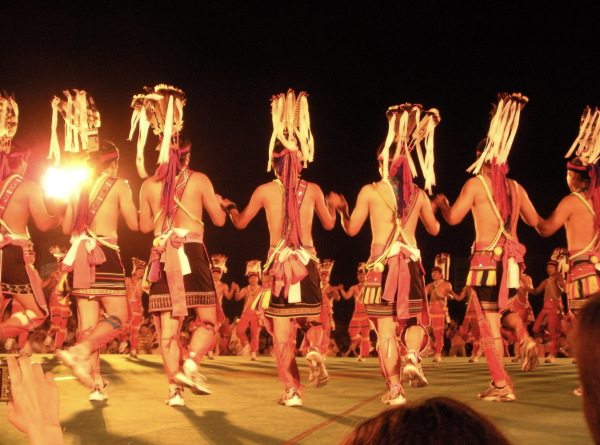
Amis annual Harvest Festival [PHOTO COURTESY OF TAKUNAWAN UNDER CC BY-SA 4.0]
Amis
The Amis span from Hualien to the Hengchun Peninsula of Pingtung, and are the largest tribe in Taiwan by far, with 213, 514 tribespeople as of 2020. As a matriarchal tribe, the females of the household typically inherit property and possessions from their mothers, while husbands must live and work in their maiden home after marriage. The Harvest Festival, a week-long celebration after harvesting rice in July, is their way of expressing their appreciation to the gods and spirits. The festivals are a time to socialize, upgrade their age rank, and see how far they have come in their military training. This tradition is particularly important for the younger generations as it is not only passed down to them but also allows them to share a collective cultural identity.
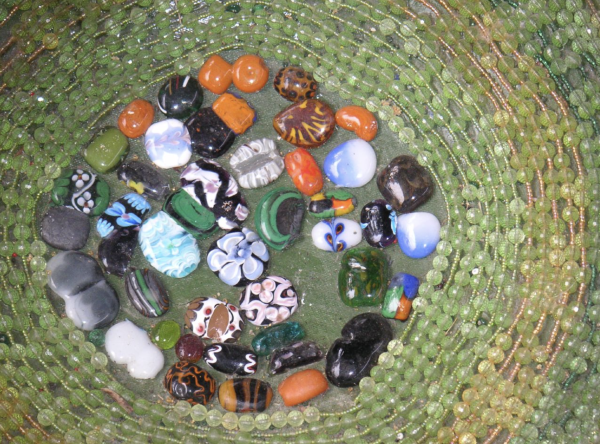
An assortment of Paiwan beads [PHOTO COURTESY OF K8 UNDER CC BY-SA 4.0]
Paiwan
The Paiwan Tribe resides in the southern part of Taiwan, and has a population of approximately 102,730 as of 2020. In the Paiwan tribe’s culture, the ancient pot, glazed beads and bronze knife are most treasured. The ancient ceramic pot, usually owned by noble families and chiefs or given as a wedding present, is not only an indicator of social status but also symbolizes the origin of life. Their most important glazed beads, such as the “bead of the tear of the sun” and the “bead of nobility and beauty,” tell traditional stories. Their bronze knives signify power and are often used at weddings and rituals.
For the non-indigenous community here at school, what is something that you hope they can learn from your community?
“We hope that the non-indigenous communities here at your school are able to understand that culture is a living part of our lives, rather than simply performances at festivals. We also hope that you will learn to view indigenous culture as a shared asset and pride of Taiwan, and to practice a more inclusive and nature-loving attitude in your daily lives.”
– Ms. Falahan, local Amis teacher
![[PHOTO COURTESY OF TAS ATHLETICS]](https://blueandgoldonline.org/wp-content/uploads/2026/05/recruited-athletes-1200x849.png)
![[PHOTO COURTESY OF DOSL, MR. PAXTON, MS. HAMRE]](https://blueandgoldonline.org/wp-content/uploads/2026/05/teachers-leaving-1200x849.png)
![[PHOTOS COURTESY OF MS. SMITH, MS. BURGER, DR. MACCONNELL]](https://blueandgoldonline.org/wp-content/uploads/2026/05/principals-1200x849.png)
![Winston and Dr. Held have class in a library study room. [AARON CHEN/THE B&G]](https://blueandgoldonline.org/wp-content/uploads/2026/05/Winston2-1200x933.png)
![After finishing their application process, seniors are ready to reflect. [PHOTO COURTESY OF CLASS OF 2026]](https://blueandgoldonline.org/wp-content/uploads/2026/05/Copy-of-Copy-of-IMG_6059-1200x675.jpg)
![A senior is caught browsing YouTube. [COLIN KUO/THE B&G]](https://blueandgoldonline.org/wp-content/uploads/2026/05/Screenshot-2026-05-16-at-1.19.10-PM.png)
