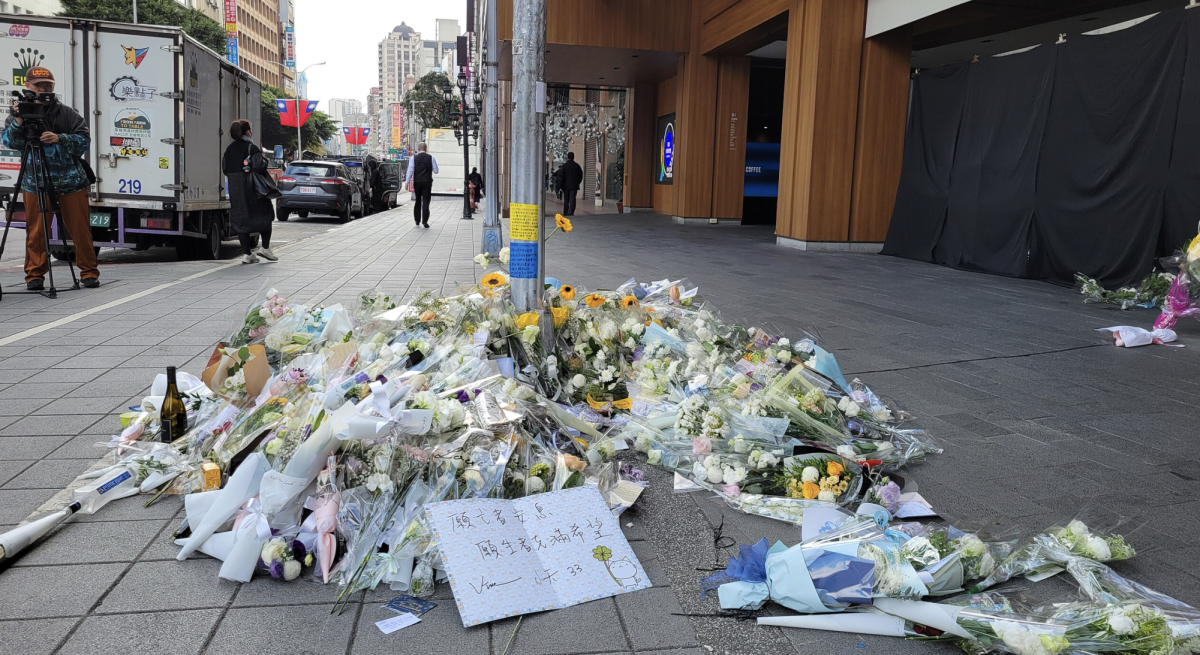
Nearing the end of our Christmas holiday, a tragic incident at Zhongshan Mass Rapid Transit (MRT) Station shattered the sense of safety amongst many Taiwanese families and sent shockwaves not just across Taiwan, but around the world.
On Dec. 19, 27-year-old Chang Wen threw smoke grenades and stabbed multiple individuals at Taipei Main Station—killing three and severely injuring eleven others. Authorities responded quickly by temporarily closing the station to begin an investigation into the incident. However, due to the rarity of such acts of public violence in Taiwan, it has left an unsettling feeling amongst many citizens. Taiwan has consistently been regarded as one of the safest places in the world where public transportation is so deeply ingrained in one’s daily life, serving as a cheap but efficient form of transportation around urban areas.
Taiwanese Premier Cho Jung-tai later shared with the public that the attack at Taipei Main Station was a “deliberate act,” although the motives were still uncertain and under investigation by authorities. The sudden disruption of this trust in public safety has forced many individuals to confront a fear they were unaccustomed to experiencing.
For students at TAS, the incident struck close to home; the event blurred the lines between distant news and a shocking reality. Many students across schools in Taiwan use the MRT as their main form of transport on weekdays and weekends, as it lessens their parents’ burden to drive their kids places and provides a cheap alternative to hiring a car service. This incident has transformed a space that was once part of a student’s daily routine into one of uncertainty and distrust. Lucy W. (‘27) shared, “I can’t believe someone would do something so horrifying in the very area students like me constantly go to get around places.”
Faculty members, on the other hand, have a different thought process with a more measured perspective than students as they reflect on Taiwan’s relative safety compared to other areas of the world. They state that we, as residents of Taiwan, should not let one incident cause excessive worry and fear. “I don’t think we should be too worried…things like these happen every day around the world, and we just need to be aware of our surroundings,” says Upper School history teacher, Mr. Richard Arnold.
The difference in perspective between students and faculty highlights how age and one’s exposure to the world shape their responses to crises. For the younger generation, the incident has created an initial shock and challenged their sense of safety, while in adults, it reinforced their understanding through years of experience in this world that no society is violence-free and even the safest countries will sometimes have anomalies that may occur. However, both perspectives share a common thought: grief for the victims and concern for the broader community of Taiwan.
Despite the fear it has generated, the Zhongshan MRT incident also revealed both the resilience and sense of community of Taiwanese society, as shown not only by the quick response from the authorities, but also the endless support shown by citizens as they paid tribute to victims at the station and shared their condolences online to the victims’ families. Taiwan’s emphasis on collective responsibility and empathy is especially visible. While the sense of security may have been interrupted, the response to the incident demonstrates that trust can be rebuilt through our compassion and unity as a society. The Zhongshan MRT attack will not be forgotten, but will be a part of how Taiwan can use this incident to evaluate safety measures in public areas and move forward together.
![[PHOTO COURTESY OF TAS ATHLETICS]](https://blueandgoldonline.org/wp-content/uploads/2026/05/recruited-athletes-1200x849.png)
![[PHOTO COURTESY OF DOSL, MR. PAXTON, MS. HAMRE]](https://blueandgoldonline.org/wp-content/uploads/2026/05/teachers-leaving-1200x849.png)
![[PHOTOS COURTESY OF MS. SMITH, MS. BURGER, DR. MACCONNELL]](https://blueandgoldonline.org/wp-content/uploads/2026/05/principals-1200x849.png)
![Winston and Dr. Held have class in a library study room. [AARON CHEN/THE B&G]](https://blueandgoldonline.org/wp-content/uploads/2026/05/Winston2-1200x933.png)
![After finishing their application process, seniors are ready to reflect. [PHOTO COURTESY OF CLASS OF 2026]](https://blueandgoldonline.org/wp-content/uploads/2026/05/Copy-of-Copy-of-IMG_6059-1200x675.jpg)
![A senior is caught browsing YouTube. [COLIN KUO/THE B&G]](https://blueandgoldonline.org/wp-content/uploads/2026/05/Screenshot-2026-05-16-at-1.19.10-PM.png)