“You are leaving behind dozens of wealthy people…you performed market manipulation and stole from them…It took them less than 5 minutes to find out exactly where you live … how often you see your lovely parents … and exactly who your … brothers and sisters are.”
These were not the words of a vengeful enemy or a political extremist. They were the words of a gambler. In March, journalist Emanuel Fabian received this death threat for the terrible offense of reporting a fact: an Iranian missile had hit Israeli territory. To the average reader, this was a standard news update, and a relatively insignificant one at that—the missile hit an open area, and nobody was hurt.
But in the distorted world of prediction markets—platforms where participants buy and sell contracts based on the outcome of future events—it was a data point that threatened a $14 million Polymarket bet. And because some argued that it was not a missile but interceptor debris and therefore should not “count,” the news report attracted unlikely yet deadly attention.
A journalist attempting to write about facts became the target of a mob of those who saw him as a threat to their profits. This is the dangerous reality of a world where prediction markets and their harms have become normalized.
Platforms such as Polymarket and Kalshi are surging in popularity. Indeed, Maria Webb of Gambling Insider found that since early 2024, monthly trading volume has increased by roughly 130 times, with the number of transactions growing from about 240 thousand to more than 43 million. Transactions also tend to spike around major global events—Polymarket surged to historic highs as the United States and Israel launched strikes on Iran. Everywhere, billions are spent to bet on geopolitical crises, and what was once hypothetical is now normalized—people are quite literally gambling on the future of the world.
Taiwan, however, has taken an entirely different approach on prediction markets, spearheading the fight against these markets’ rise.
Unlike many jurisdictions where prediction markets operate in supported environments or legal grey zones, Taiwan has maintained a firm stance against these platforms from the beginning of their rise. In the buildup to the 2024 presidential election, 17 people were arrested in coordinated raids for betting on the election’s outcome on Polymarket, according to an article by Taiwan News. Since then, the government has maintained strict prohibitions on prediction markets, citing the numerous issues that they pose.
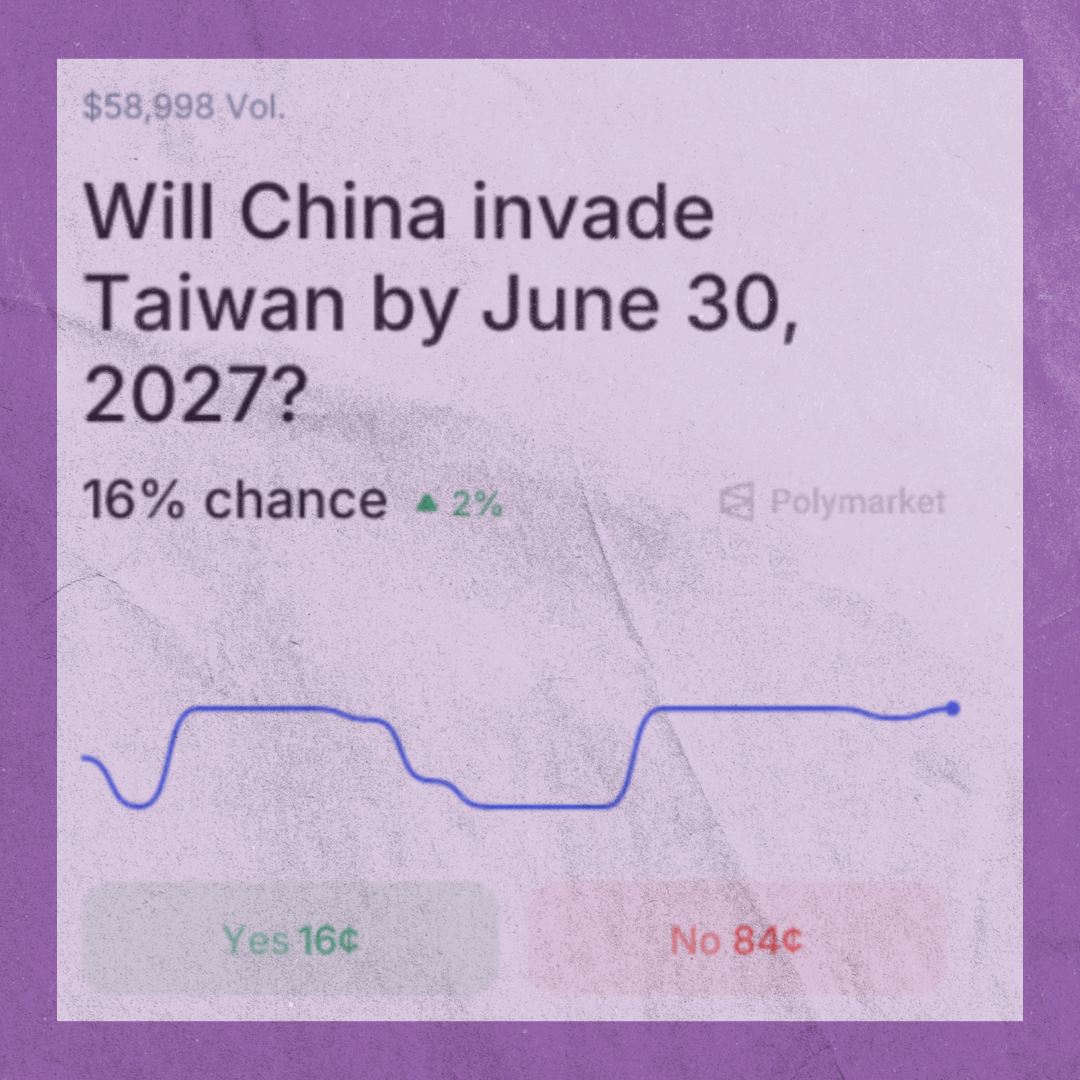
One obvious issue is moral. Prediction markets are commodifying real, lived suffering. For Taiwan, this hits particularly close to home. On Polymarket, users are betting on the probability of a Chinese invasion, with one, by the name of comon119, betting around $108,300 on the “Yes” outcome of the event. In this system, Taiwan’s future is reduced to a tradable asset where users have the potential to massively profit from mass suffering.
This potential also extends the issue beyond morality. When people can “win big” from geopolitical events, they have the incentive to exploit confidential information. A Taiwanese citizen with state secrets, for instance, may sell this information to the Chinese government and place a prediction market bet on the odds of Chinese military action against Taiwan. While this is purely speculation, it is not far from reality elsewhere. Right before Trump announced winding down strikes on Iran, a series of new accounts were created and used to bet millions on a ceasefire, generating massive payouts, according to Bloomberg. This points to insider trading.
Moreover, prediction markets can incite intimidation and coercion. Before the death threats, Emanuel Fabian was also offered bribes and relentlessly harassed by bettors demanding that he change his story to secure their winnings. This creates a terrifying paradigm where people are literally coerced into rewriting reality to satisfy ledgers.
Taiwan’s stance is a clear signal against prediction markets, showing that the nation refuses to allow its sovereignty to be auctioned off or for its citizens to be endangered by the moral and physical pitfalls of gambling. As the volatility of these markets begins to seriously impact the real world, other countries must follow Taiwan’s lead before their own tragedies become someone else’s jackpot.
![After finishing their application process, seniors are ready to reflect. [PHOTO COURTESY OF CLASS OF 2026]](https://blueandgoldonline.org/wp-content/uploads/2026/05/Copy-of-Copy-of-IMG_6059-1200x675.jpg)